
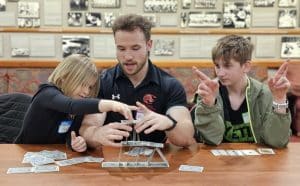
SUNY Cortland Mentor working with Compass Youth
Mentoring—pairing youth with supportive, responsible & caring adults—has long been a successful prevention strategy for helping young people in our community.
The journey began in 1970 when Family Court Judge Richard Shay noticed that young people appearing in his court lacked constructive alternatives. In response, he helped form a committee that secured a grant from the Ford Foundation, leading to the creation of the Volunteer Family Counseling Service of Cortland County. This initiative aimed to determine if trained community volunteers could offer effective family counseling. It became the first organization in New York State to redirect juveniles from family court into a counseling program.
The initial success of these volunteer counselors spurred the agency to introduce a youth mentoring program. Volunteers provided one-on-one support to at-risk youth, and as community demand grew, so did the program. Services expanded to include treatment for child sexual abuse, court diversion counseling, and substance abuse treatment, eventually incorporating a licensed mental health clinic.
In 1990, the organization transitioned from using volunteers to employing professional counselors and changed its name to Family Counseling Services of Cortland County. Alongside this shift, the volunteer youth mentoring program continued to flourish. In 2013, Family Counseling Services successfully merged with Cortland Prevention Resources (CPR), which now oversees the Compass Program.
The Compass Program, a collaboration with the Adapted Physical Education Department at SUNY Cortland, pairs youth with college mentors who help them develop social skills and positive character traits. Students in grades 6-12 are partnered with college mentors who model healthy behaviors, promote healthy lifestyles, and engage in fun, constructive activities each week. Research shows these relationships offer numerous benefits, including:
- Increased high school graduation rates
- Healthier relationships and lifestyle choices
- Better attitudes toward school
- Increased college enrollment and higher educational aspirations
- Enhanced self-esteem and confidence
- Improved behavior at home and school
- Stronger, healthier relationships with parents, teachers, and peers
- Stronger interpersonal skills
- Decreased likelihood of initiating drug and alcohol use
(MENTOR, 2009; Cavell, DuBois, Karcher, Keller, & Rhodes, 2009)
Not only do the benefits impact the mentee, but the mentor is also able to grow and learn from the experience. Mentors are able to use this program as a way to further their community interactions, gain insight into working directly with youth, and learn what it means to plan and facilitate meaningful group activities. According to youth.gov further benefits for Mentors may include:
- Increased self-esteem
- A sense of accomplishment
- Networking opportunities
- Insight into various stages of youth development
- Enhanced patience and supervisory skills
Could your child or someone you know benefit from the guidance of a positive role model? Are you looking for ways to boost their confidence and overall well-being? Call our office at (607) 756-8970 x260 to learn more about this program and to register.
By Jennifer Sylstra, Prevention Program Coordinator